




 FREE Download
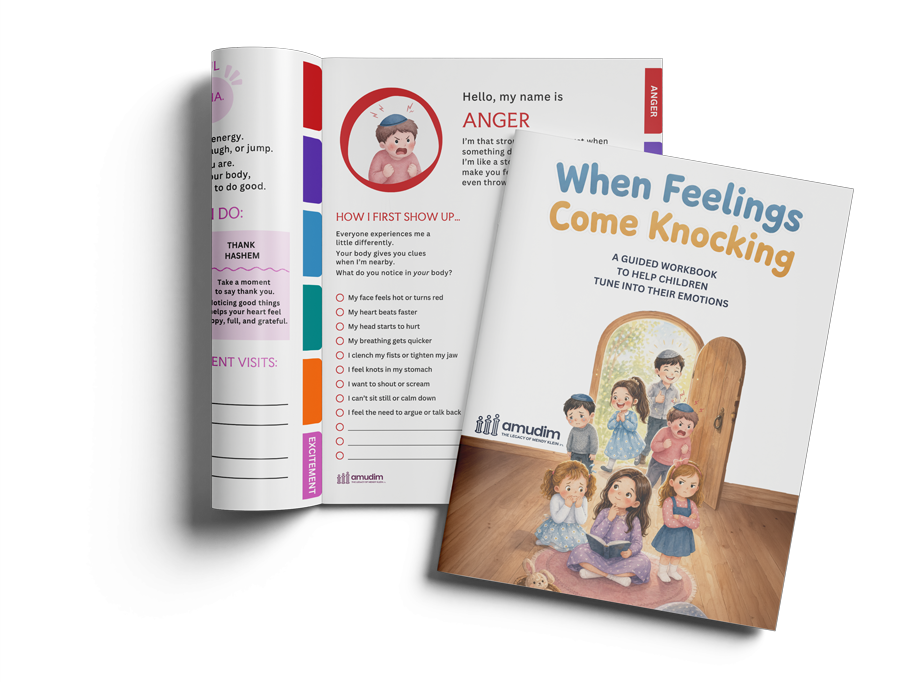
WHEN FEELINGS COME KNOCKING A Guided Workbook to Help Children Tune Into Their Emotions

At Amudim, we believe education is prevention.
That’s why we’re in classrooms, at community events, and in shuls — building awareness, teaching skills, and helping create a safer world for all of us before a crisis ever begins.
And when someone is in crisis, our clinical case managers are there, too. A phone call, a plan, and someone walking alongside them through it — always 100% free.
That’s only possible because of our donors. If you want to help us keep showing up for Klal Yisroel, you can do that here.
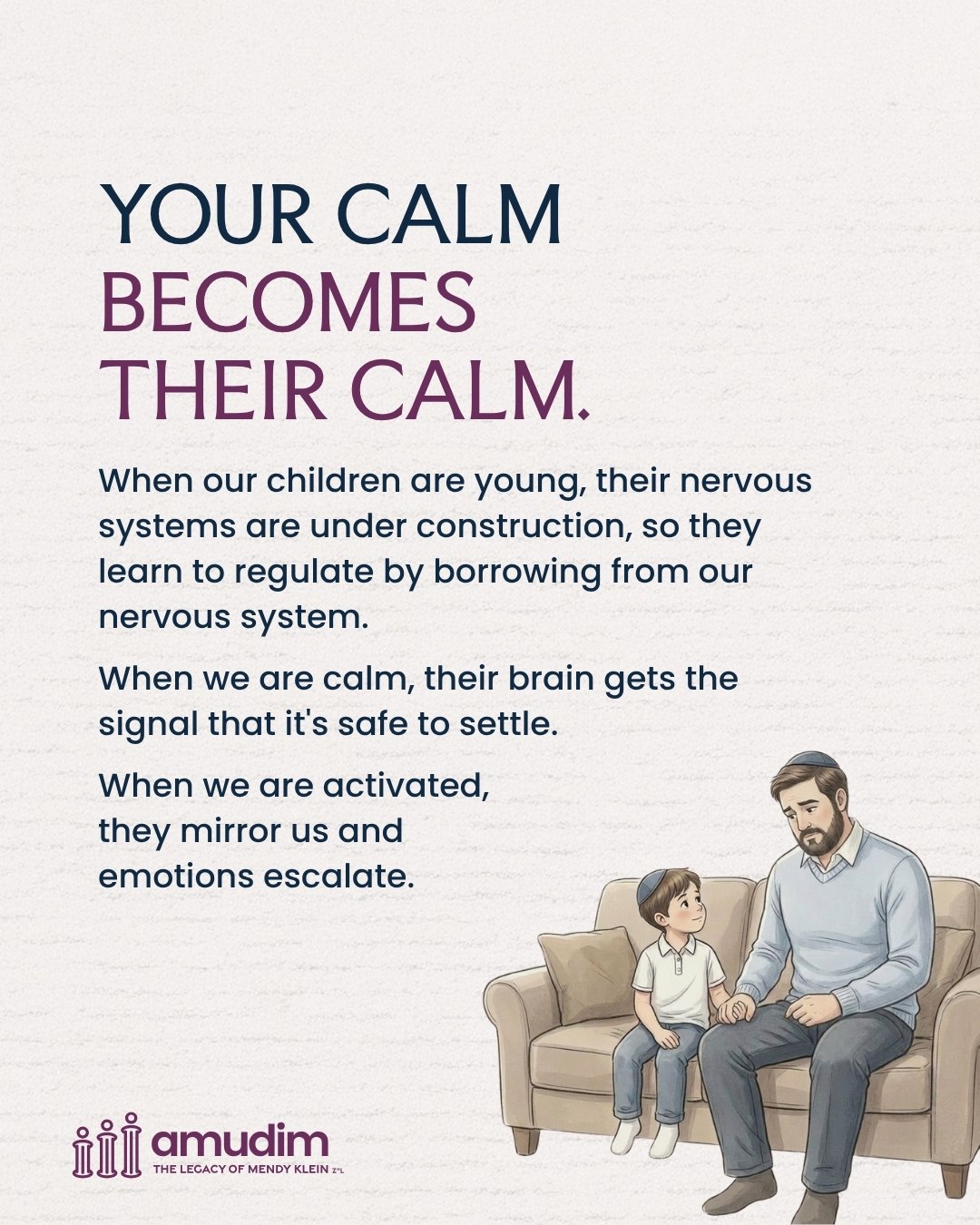
On Tuesday we spoke about how regulation begins with the parents, how our child’s nervous system relies on ours to set the tone, and how noticing our own patterns is the first step toward responding differently.
Today we’re getting practical about it. How do we work regulation into our daily life in a way that makes sense for us? What are a few small practices we can incorporate into our day before we find ourselves stuck in an emotionally challenging moment.
We’re going to discuss some ways we can build our self-awareness and feel steadied within ourselves before the hard times hit.
And once we’ve gained that steadiness in ourselves, we can start helping our children build theirs too.
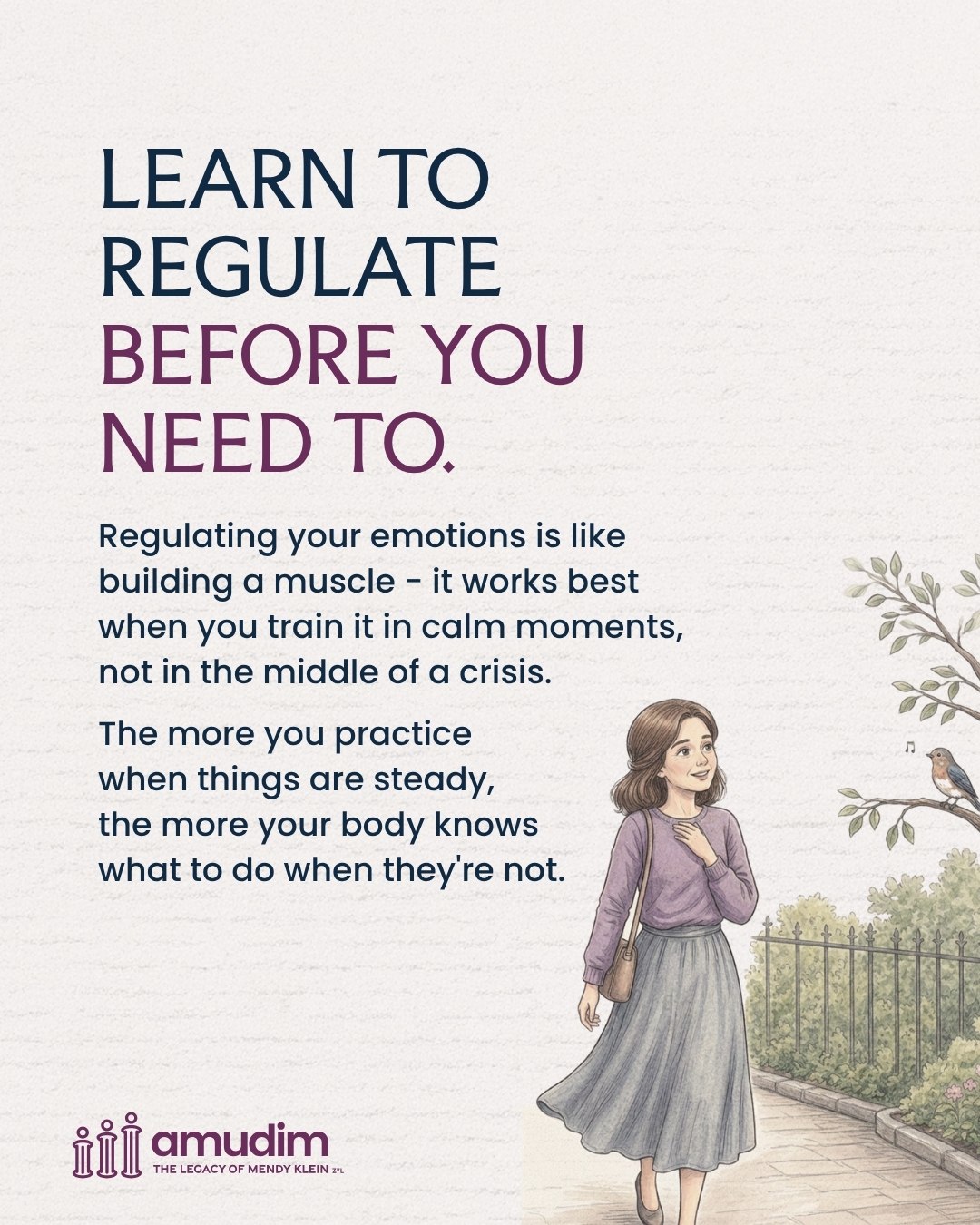
Regulate before you have to regulate.
Shira Berkowitz, LCSW and Director of Darcheinu, often says: “Don’t wait until you’re in a crisis to try to calm down. Practice when things are calm.”
This sounds simple, but is often overlooked. We don’t find access to regulation in a single moment but by practicing the skill like we would any other skill.
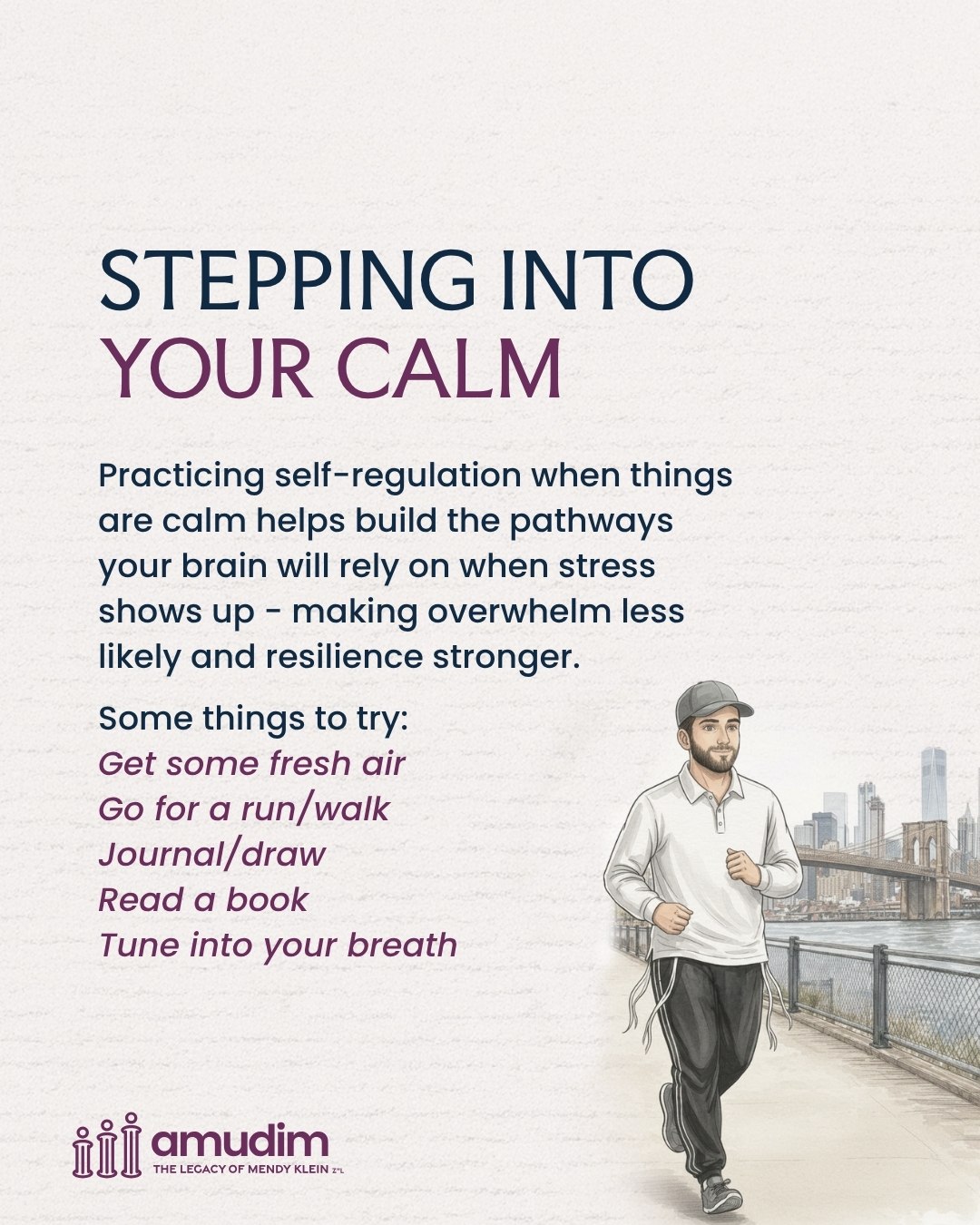
Our goal is to train our nervous system over time so that calm isn’t something we scramble for during the intensity of emotion. It’s something our body already knows how to find.
Here are a few ways we can build those skills:
Morning breathing. Before we start our morning, take an extra few minutes. Take 10 deep breaths. In through our nose, hold, and then breathe out through our mouth. It takes less than two minutes and it sets our baseline for the day.
Grounding with our senses. On a walk, in carpool, or standing at the kitchen counter – pause and notice one thing you see, hear, smell, feel, and taste. This helps pull us out of the emotional chaos we are feeling and back into the present moment.
End-of-day grounding. Before we fall asleep, do the same breathing or grounding exercise. It helps our body release what it’s carried all day and signals that it’s safe to rest.
These aren’t big commitments. They’re tiny daily deposits into a ‘calm account’ that you’ll draw from when things get hard. Because when stress piles up without a break – from work to carpool to homework battles to bedtime – our body never gets back to baseline. We’re not calm. We’re running on fumes. And the next small thing has the potential to tip us over.
Building in these small resets during the day is how we break that cycle with purpose and intention.
Check ourselves: is it us or is it them?
Sometimes our child does something mildly frustrating and our reaction is enormous. That gap between what happened and how we responded is usually a sign that something else is going on with us.
Rabbi Yisroel Grossberg, M.S. Ed., Educational Director of Darcheinu, puts it simply: “I’m man enough to admit that I’m like a little kid. If I’m hungry, I’m kvetchy. There are times where I look at my kid and say, let’s have this conversation after I eat. Because it’s not you, it’s me.”
That kind of honesty is regulation. He noticed his internal state, named it, and decided not to let it drive the conversation.
There’s a deeper version of this check.
When our child breaks a rule and we feel that flash of anger, we can pause and ask ourselves:
Did they do this to us, or did they do this to themselves?
Is our reaction helping our child grow – or is it coming from our own hurt, because they didn’t follow our rule?
If our goal is to be mechanech our children, our reaction needs to come from clarity, not anger.
And it goes both ways. If our child comes home and is falling apart over something small, it might not be about the small thing. They might be hungry, overtired, or carrying something bigger they’re not ready to talk about. Reading that, in ourselves and in our kids, is regulation in action.
Choose our moment.
When we need to have a hard conversation, the timing and setting matter as much as the words.
If we bring up curfew while our child is walking out the door with a friend honking outside, it’s never going to go well. But if we have that same conversation the night before, when everyone is calm, maybe over a snack, maybe on a drive, it changes everything.
Rabbi Grossberg shared that some of his most difficult conversations happened over slurpees. Not because the conversations were light, but because the setting was. Having something in their hands, the car moving, the pressure off – it lowered the temperature enough for the real talk to happen.
And, the Shabbos table may not be the time to have that conversation. Thursday night might be the time. Over kugel. When everyone’s calm. It doesn’t take away from the seriousness. It just removes the reactivity.
Fill our cup.
This is not a luxury. It is a strategy.
When we’re running on empty, we don’t have the bandwidth to pause. We don’t have the awareness to catch our clenched jaw. We don’t have the energy to be the Time-Released Reactor instead of the Atomic one.
Taking time for ourselves – a walk with a friend, a half hour on Friday afternoon, a date night…it’s what makes everything else in this email possible.
We need this time for ourselves in order to show up as the best parent we can be. There’s more to give when our cup is full.
This shouldn’t feel like selfishness at all. It’s recognizing that you can’t regulate from empty.
When we're already activated.
Sometimes we miss the early signals and we’re already in it. Our heart is pounding. Our voice is rising. And we are on the verge of saying things we’ll regret later.
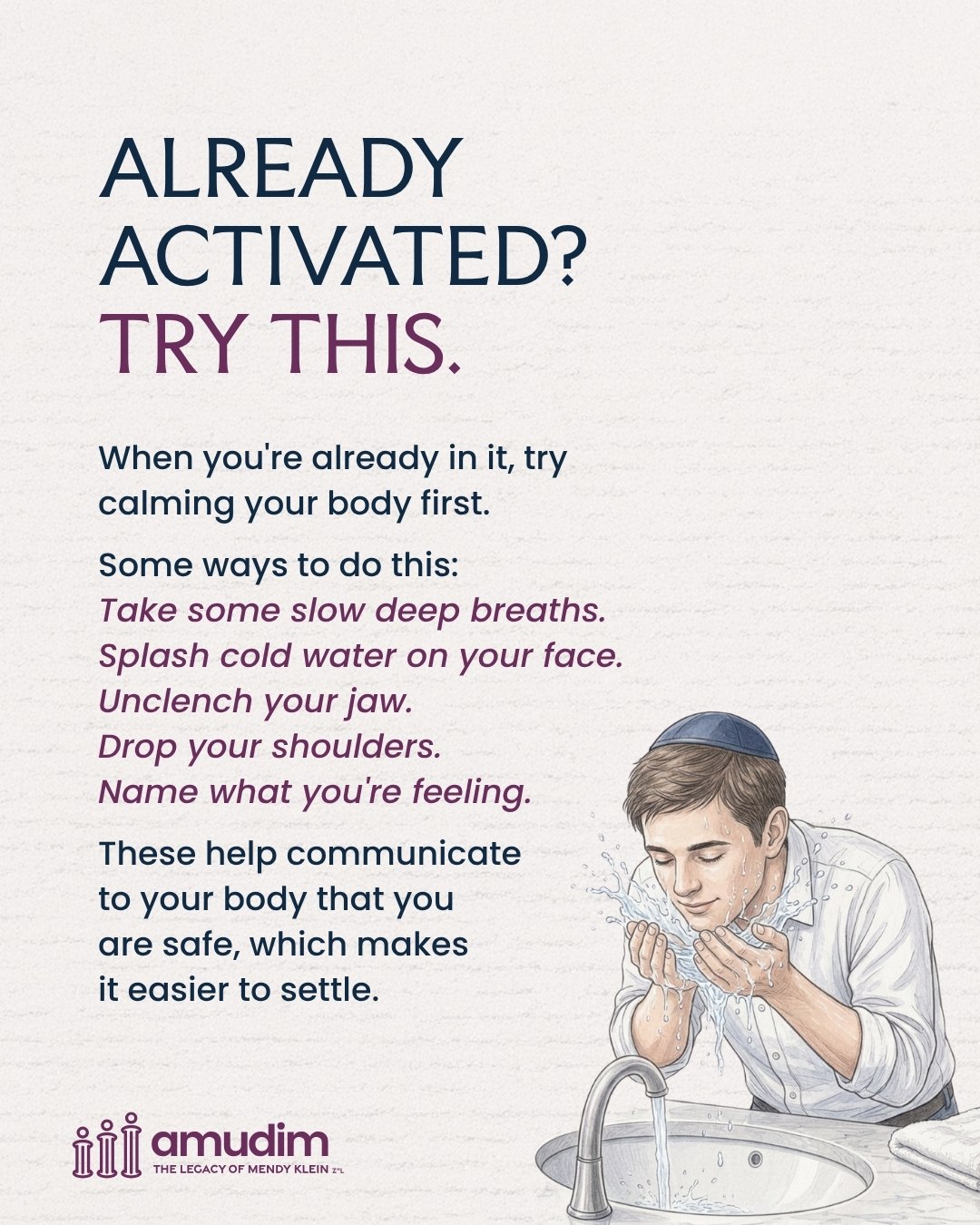
The good news is that even here, there are ways out of it… that actually work. The key is to settle our body first. When we signal to our body that we are safe, we can feel the tension begin to soften.
The 60-second reset. We don’t need an hour. We just need one minute.
Walk to another room in the house or take a step outside. Just break the loop. Then when we walk back into the same situation, we have given ourselves that pause that enables us to approach things in a new way.
Cold water. Splash it on our face or hold something cold. This triggers the body’s dive reflex, which slows our heart rate and pulls us out of fight-or-flight. It’s how our biology works and a quick, clever way to reset our nervous system in under 30 seconds.
The long exhale. Not a deep breath in, a slow breath out. Breathe in for 4 counts, hold for 4, breathe out for 6 to 8 counts. The exhale is what activates the part of our nervous system that calms us down.
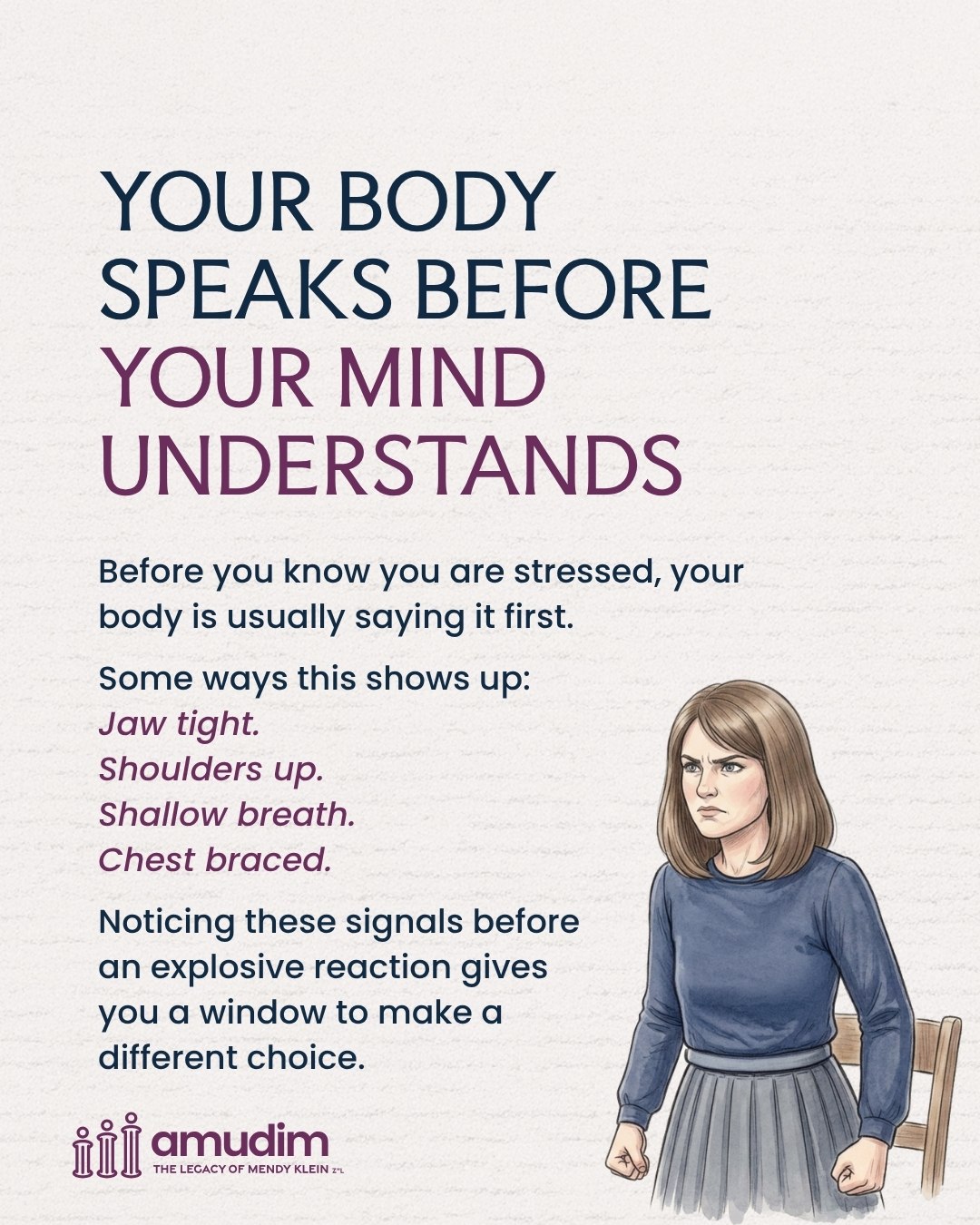
Unclench. Check our jaw. Drop our shoulders. Press our tongue to the roof of our mouth. Let our upper and lower teeth separate. These are places we hold tension without realizing it, and releasing them sends a signal to our brain that the emergency is over.
Feet on the floor. Press our feet flat into the ground. Feel the floor underneath us.
This is grounding that moves our attention out of the storm in our head and into our body, where things are actually stable.
Name what we’re feeling. This connects right back to what we learned in Week 1. Putting words to the emotion – even just silently to ourselves – helps quiet the brain’s alarm system so the thinking part can come back online.
The pivot phrase. Have a go-to line ready for when we feel ourselves about to react. “I hear you. Let me think about that.”, or “We’re going to talk about this. Just not right now.”
We’re not avoiding it. We’re buying ourselves the time to respond instead of react.
TRY THIS AT HOME:
Pick one thing from today’s toolkit. Just one.
Proactive: Try 10 deep breaths before your day begins tomorrow morning.
Reactive: Next time you feel your voice rising, try the 60-second reset or the pivot phrase.
The honest check: Next time your reaction feels bigger than the moment, ask yourself, am I hungry? Tired? Is this about them or about me?
With your kids: Try doing one of these techniques together this week. The long exhale before homework. The five senses check on the walk home. You don’t have to explain it. Just do it with them and let them feel what it’s like.
The goal isn’t to get all of these right. It’s to catch one moment this week where you paused instead of reacted. That’s regulation. And every time we do it, we’re showing our children how it’s done.