



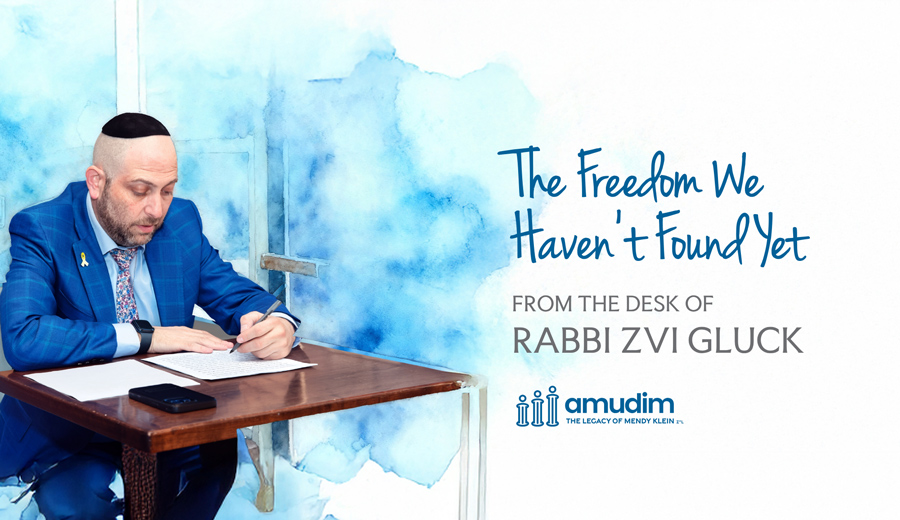
The Freedom We Haven’t Found Yet
Every year at the Seder we raise the broken matzah and retell the story of yetzias Mitzrayim, saying words that have been repeated for centuries. We don’t just celebrate freedom; we sing about it and taste it in the foods we eat and the four cups we drink, all the while reclining like royalty.
Plan Your Pesach
Daily tools to help you navigate this season
But this Pesach, I wonder how many of us are free in the truest, most personal sense. How many people will be sitting at their Seder imprisoned by the belief that no one understands their trauma, or cares enough to help? How many in our communities are enslaved by addiction, shame, the aftermath of abuse, or the crushing grip of untreated mental illness?
Sadly, Pesach isn’t a celebration for many members of our community. It’s a performance, as they sit at the Seder discussing freedom, while inside, they’re still in their personal Mitzrayim.
I’ve spent my life working with people in crisis. I’ve been on the phone at all hours helping parents find ways to tell their family that one of their children is struggling with addiction. I’ve sat with survivors of abuse who spent years convinced that what happened to them was their fault, or that coming forward would destroy their lives. I’ve held the hands of individuals who looked like they had everything, while deep down inside they were falling apart. Those experiences have taught me that silence isn’t protection, it’s a prison.
When we tell someone, even implicitly, that their struggle is too shameful to talk about, we aren’t protecting our community, we’re keeping it in chains. And as a community that prides itself on chesed and achrayus, we can’t keep looking away.
This Pesach, I am asking you to make be the person who reaches out to someone who is struggling with the simple and powerful message: I see you, and you aren’t alone. If you yourself are struggling, know that help exists, and that reaching out isn’t a sign of weakness, it’s the first step towards freedom.
But there can be no discussion of freedom without acknowledging what’s happening in our world right now. The antisemitism we experienced in Mitzrayim is surging with a shocking ferocity. Jews are being targeted, harassed, and threatened on college campuses, on city streets, in legislatures, and on social media. Seemingly safe institutions have shown themselves to be indifferent, or worse. The oldest hatred has found new language and new platforms, and it is spreading.
In Israel, the sustained reality of grief, trauma, and resilience defies description. Families are being torn apart, communities are still displaced, and a nation is carrying a weight that the world too often minimizes. Having spent time there, I’ve seen how hard it is to keep moving forward when the cost has been staggering. The current situation is a human crisis that demands our sustained attention, our advocacy, our solidarity, and our tefilos. We cannot afford compassion fatigue when the people we love are hurting so badly.
Taking all those themes together underscores how even years after yetzias Mitzrayim, our yearning for freedom is as palpable as ever.
Parro’s greatest weapon wasn’t the whips or the bricks, but his ability to convince Bnei Yisroel that this was the only life available to them, and that imagining anything else was pointless. That same lie resonates in the struggles we see today, from people who believe their addiction defines them forever, to survivors who think that the trauma of Jewish existence is unavoidable, and a world that insists that Israel’s grief is complicated and its defense is controversial.
The Exodus begins the moment we believe that things do not have to stay this way.
Freedom is not the absence of struggle. It is the refusal to accept that the struggle is the end of the story.
This Pesach, as you sit at your Seder, consider who in your life might still be waiting for their yetzias Mitzrayim. Think about the person who hasn’t asked for help because they don’t believe it’s available, and what it would mean to be the one who opens the door for them. Think about our people in Israel and around the world,who are fighting for something we take for granted: the right to exist in safety, dignity, and peace.
The road to freedom is rarely straight. But no one should have to travel it alone.
Chag Pesach Kasher V’Sameach.