




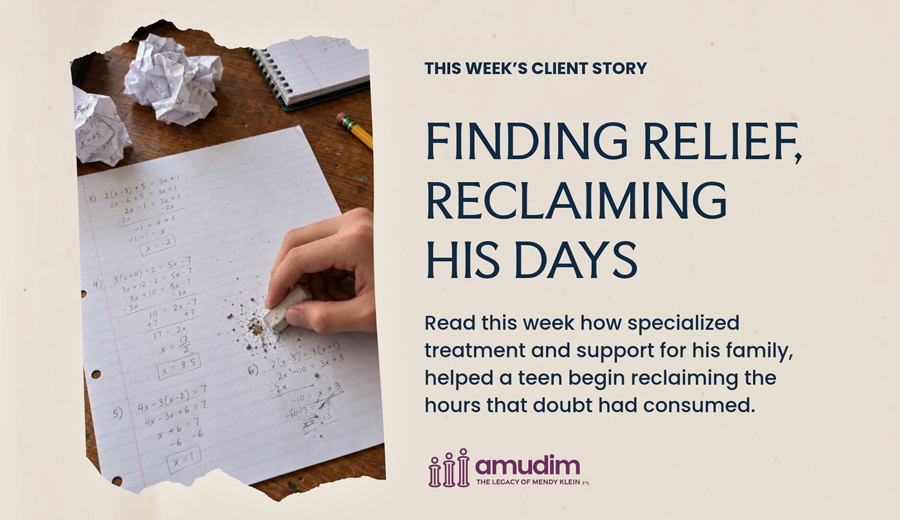
Finding Relief, Reclaiming His Days
October 23, 2026
By the time Eli’s* parents called Amudim, his younger siblings had stopped knocking on his bedroom door.
The fifteen-year-old had become increasingly upset over interruptions. If someone moved something on his desk or called him downstairs before he was ready, he could erupt into shouting. Getting out of the house each morning took so long that his father was regularly late to work. His parents were receiving calls about missed classes, and homework kept him awake well past midnight.
They could see that Eli was struggling. They also saw how much the tension was affecting their other children. After months of arguments and unsuccessful attempts to help, they began looking into an out-of-town program.
When his father called Amudim, he wanted help deciding whether it was time.
Our case manager asked him to describe a typical day. As they spoke, details emerged that had been getting lost in the arguments. Eli checked his schoolbag repeatedly, taking everything out and packing it again. He erased and rewrote assignments until the paper tore. At bedtime, he asked the same questions over and over, becoming distressed if his parents answered differently.
Our case manager helped arrange an evaluation with a clinician experienced in adolescent anxiety and OCD. Eli was subsequently diagnosed with obsessive-compulsive disorder. Much of what his family had understood as stubbornness was happening when he felt compelled to repeat something or became frightened that he had made a mistake.
Understanding that gave the family a clearer place to begin.
Following the assessment, his clinician recommended specialized outpatient treatment. Amudim helped his parents find an appropriate provider and work through insurance and scheduling obstacles. Our case manager also helped them prepare questions about how they would know whether Eli needed more intensive care.
His parents participated in sessions, learning how to respond when Eli repeatedly sought reassurance and how to support treatment at home. With Eli’s involvement, his school arranged temporary adjustments so he could continue attending while working on the symptoms that were consuming so much of his day.
Progress took time. There were mornings when he still could not get out on schedule, and evenings when his parents wondered whether the plan was helping. Our case manager stayed in touch, helping them bring those concerns back to his treatment team.
Several months later, Eli was getting to school more consistently. Homework still took effort, but it no longer occupied nearly every evening. His siblings began coming into his room again, and he was more able to tolerate the ordinary interruptions of a busy home.
His parents had called believing they might have to send him away. The assessment helped them understand his needs and make an informed decision about his care. For Eli, that meant beginning treatment close to home, with his family learning alongside him.
If you’re worried about someone you love and unsure what kind of help they need, reach out. Amudim is here to help you work through the next steps.
*Names and details have been changed to protect privacy.
Week Ending October 23, 2026
Each week, Amudim fields calls covering a wide range of crises and addressing various human concerns, including addiction, depression, abuse, health and domestic emergencies and many others. We track the calls and breakdown of issues for many reasons, foremost of which is to consistently improve and strengthen our knowledge and ability to address community’s needs.
Social Media

What Is a Boundary, Anyway?
Our children begin learning about boundaries long before they even know the word.
And so much of that learning happens in the little moments we share with them every day.
In today’s video, Mrs. Shira Berkowitz, LCSW, and Rabbi Avi Landa, LCPC, walk us through age-appropriate ways to introduce boundaries as our children grow, helping them understand how to respect someone else’s space while learning that their own deserves respect, too.
In The News

Lessons Learned from a Consent Campaign that Backfired
What should have been a teachable moment turned into a train wreck, when a campaign emphasizing the importance of boundaries crossed a line of its own, portraying a seemingly loving grandmother in what many saw as a predatory light.